

Introduction
If you are planning a swimming pool project, understanding the swimming pool waterproofing cost delhi is an important part of budgeting. The final cost depends on the pool’s size, surface condition, waterproofing material, labour, and finishing requirements. A basic coating may cost less initially, but a complete system with proper crack repairs, waterproofing, testing, and finishing can offer better long-term protection.
A swimming pool should hold water without leaks, cracks, or damage to its surrounding structure. However, constant water pressure, temperature changes, ground movement, and poor construction can gradually weaken a pool’s waterproofing system. Even a small leak can increase water bills, damage nearby walls, affect the pool deck, and lead to expensive repairs.
Choosing the right Swimming pool waterproofing system helps protect the pool structure and extends its service life. Whether you are constructing a new swimming pool or repairing an existing one, the right materials and application process make a significant difference.
In this guide, we explain the most commonly used waterproofing materials, the step-by-step application process, estimated Delhi NCR prices, and practical tips to help you make an informed decision.
Common Waterproofing Materials Used for Swimming Pools
Different swimming pools require different waterproofing systems. The choice depends on whether the pool is made of concrete, whether it is newly constructed or being renovated, and whether tiles or another finish will be installed.
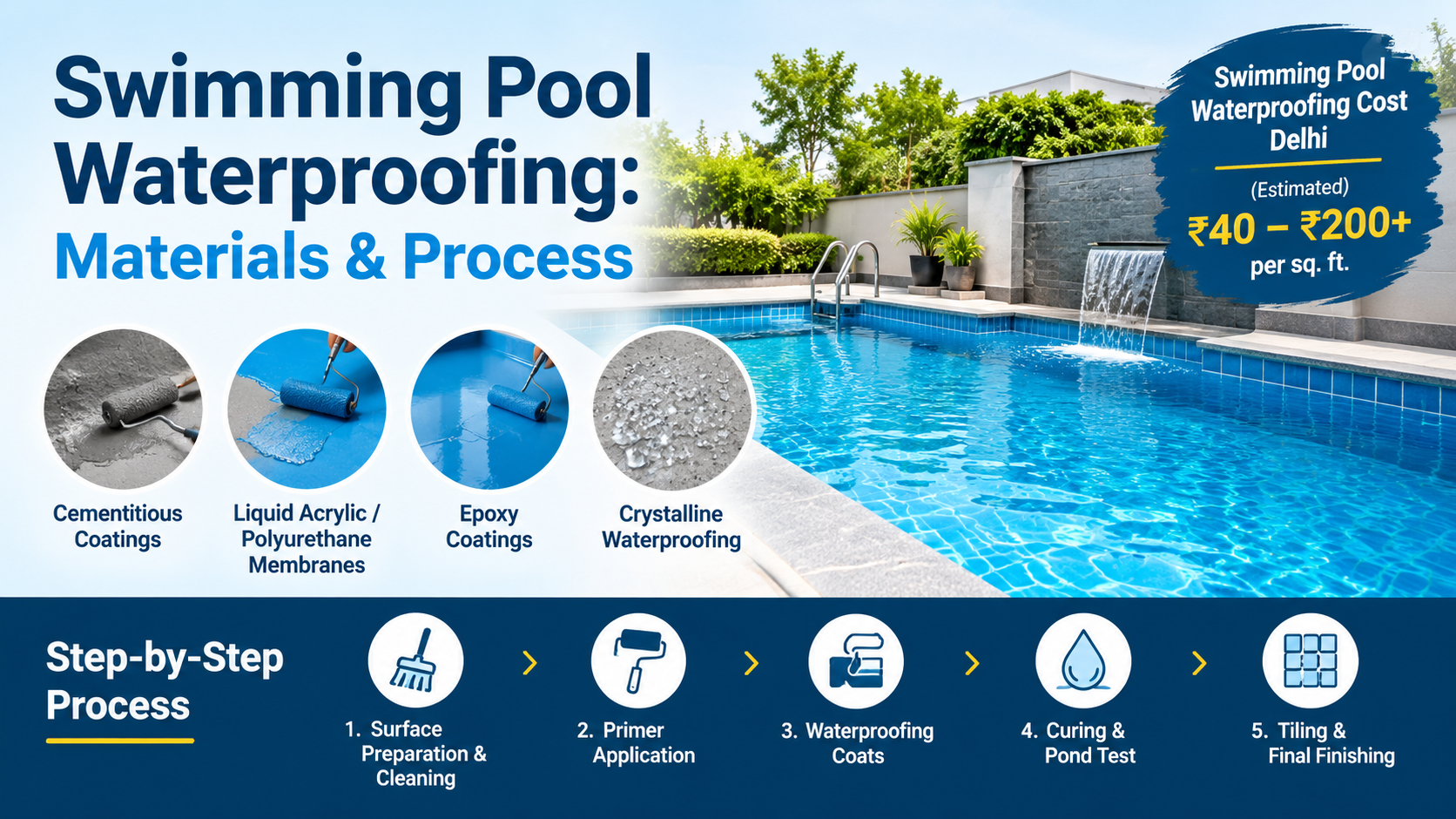
1. Cementitious Waterproofing Coatings
Cementitious waterproofing is a popular choice for concrete swimming pools. These coatings usually contain cement, selected fillers, and special polymers that improve bonding and water resistance.
Advantages:
- Bonds well with properly prepared concrete surfaces.
- Suitable for many new swimming pool construction projects.
- Can be applied to walls, floors, and other compatible cement-based surfaces.
- Relatively straightforward to apply compared with some specialist systems.
Limitations: Standard cementitious coatings have limited flexibility. They may not accommodate significant structural movement or active cracks unless the system is specifically designed for that purpose.
Best use: Concrete pools where the substrate is stable and the selected product is approved for continuous water immersion and the intended pool finish.
2. Liquid Acrylic and Polyurethane Membranes
Liquid waterproofing membranes are applied with a brush, roller, or suitable spray equipment. After curing, they form a continuous protective layer over the prepared surface.
Acrylic membranes are generally easier to apply and can provide good flexibility in suitable applications. However, not every acrylic product is suitable for permanent immersion.
Polyurethane membranes can offer excellent flexibility and crack-bridging properties when the correct product is selected. They are often considered for projects requiring a more flexible waterproofing layer.
Advantages:
- Creates a continuous layer with fewer joints.
- Can accommodate limited movement when designed for it.
- Useful for complex corners and changes in surface direction.
Limitations: Product compatibility, application thickness, moisture conditions, and curing requirements must be checked carefully. Some membranes require a protective screed or a compatible bonding layer before tiling.
Best use: Pools requiring a flexible membrane, provided the manufacturer approves the system for submerged conditions and the proposed finish.
3. Epoxy Waterproofing Coatings
Epoxy coatings are resin-based systems that can provide a hard, dense, and durable surface when applied correctly. Some are designed as protective finishes for swimming pools, while others are intended for different industrial applications.
Advantages:
- Can provide a smooth, easy-to-clean finish.
- Offers good resistance to chemicals when the correct formulation is used.
- Suitable for certain renovation projects and specialist pool finishes.
Limitations: Epoxy is generally less flexible than elastomeric membranes. It requires careful surface preparation and may not be suitable for substrates with significant movement. Ordinary epoxy paint should not be assumed to provide reliable structural waterproofing.
Best use: Pools where a purpose-designed immersion-grade epoxy system is specified as part of a compatible coating or finishing system.
4. Crystalline Waterproofing
Crystalline waterproofing products contain reactive chemicals that penetrate suitable cement-based materials and form insoluble crystals within their pores and capillaries, reducing water penetration.
Advantages:
- Works within suitable concrete rather than relying only on a surface film.
- Can reduce water penetration through sound concrete.
- May be used as an integral treatment or surface-applied system, depending on the product.
Limitations: It cannot replace proper structural repairs, joint treatment, or flexible crack-bridging membranes where these are needed. Its performance depends on concrete quality, moisture conditions, and correct application.
Best use: Suitable concrete pools where reducing permeability is a priority and the selected system is approved for the specific application.
The most important rule is to choose a complete, compatible waterproofing system rather than selecting a product based only on its price. The material must be suitable for continuous immersion, pool chemicals, the substrate, and the intended tile or finish.
Step-by-Step Swimming Pool Waterproofing Process
A reliable waterproofing system depends as much on correct preparation and testing as it does on the material itself.
Step 1: Surface Preparation and Cleaning
The first step is to inspect the pool floor, walls, corners, construction joints, pipe penetrations, and surrounding concrete.
Remove loose concrete, dust, oil, old coatings, and any material that could prevent proper bonding. Cracks must be assessed to determine whether they are superficial, caused by shrinkage, or related to structural movement.
The contractor should then:
- Repair suitable cracks with an appropriate repair system.
- Remove weak or damaged concrete and restore the surface.
- Treat construction joints, corners, and pipe entries using compatible detailing materials.
- Ensure the surface meets the selected product’s requirements for cleanliness, moisture, and profile.
Active leaks and structural cracks should be investigated before waterproofing begins. Simply covering them with another coating can lead to failure.
Step 2: Apply the Recommended Primer
Some waterproofing systems require a primer to improve adhesion between the substrate and the main coating. Others are designed to be applied directly to a properly prepared surface.
The primer, if required, must be compatible with both the substrate and the waterproofing material. The contractor should follow the manufacturer’s instructions for coverage, drying time, and application conditions.
Skipping a required primer or applying the next layer too early can weaken the bond and shorten the life of the waterproofing system.
Step 3: Apply the Main Waterproofing Coats
Once the surface is ready, the selected waterproofing material is applied at the specified coverage rate and thickness.
For a typical coating or membrane system, the work may involve:
- Applying the first coat evenly across the pool floor and walls.
- Reinforcing corners, joints, and pipe penetrations where specified.
- Allowing the first coat to dry or cure as instructed.
- Applying additional coats in the required direction and sequence.
- Checking the finished thickness and ensuring there are no pinholes, gaps, or missed areas.
The number of coats depends on the product specification. Applying more material than recommended does not automatically improve performance; the correct thickness and curing conditions are what matter.
Step 4: Curing and Pond Testing
Allow the waterproofing system to cure for the full period specified by its manufacturer. Testing too early can damage the coating or produce misleading results.
After curing, conduct a controlled pond test by filling the pool to the appropriate level and monitoring the water level for the specified period. A test lasting around 48–72 hours may be used in some projects, but the required duration should be established by the project specification and site conditions.
During testing, account for evaporation, rainfall, and other factors that can affect water levels. Inspect accessible surrounding areas for damp patches and leakage.
A pond test is a practical way to identify leaks before tiling. However, it does not replace structural assessment or any additional testing required by the project.
Step 5: Tiling and Final Finishing
Only after the waterproofing system has passed the required checks should the contractor proceed with the specified protection layer, tile adhesive, and finishing materials.
Use adhesives and grouts compatible with both the waterproofing system and continuous water immersion. Pay particular attention to movement joints, corners, and fittings.
After finishing, follow the specified curing period before filling the pool and introducing treatment chemicals. Keep product records, warranties, and test reports for future maintenance.
Swimming Pool Waterproofing Cost Delhi: Price Breakdown and Market Guide
The swimming pool waterproofing cost delhi depends on the pool’s condition, the waterproofing system selected, and the amount of repair work required before application. New pools with sound concrete may require less preparation than older pools with recurring leaks, damaged tiles, or structural cracks.
Estimated Swimming Pool Waterproofing Cost in Delhi NCR
The following figures are indicative budgeting estimates, not verified quotations. Actual prices vary by contractor, product specification, site access, and project size.
| Waterproofing work | Indicative cost per sq. ft. |
| Basic cementitious coating | ₹40–₹80 |
| Polymer-modified waterproofing system | ₹60–₹120 |
| Flexible liquid membrane system | ₹80–₹160 |
| Specialist polyurethane system | ₹100–₹200+ |
| Surface preparation and minor repairs | ₹15–₹50 extra |
These estimates generally refer to waterproofing work and associated preparation, where applicable. They do not automatically include structural repairs, complete tile removal and replacement, tile adhesive, new tiles, plumbing repairs, or extensive joint treatment. Confirm the inclusions before comparing quotations.
What Affects Swimming Pool Waterproofing Cost?
1. Pool size: Larger pools have more surface area to cover. However, very small pools can have a higher per-square-foot cost because fixed setup and labour expenses are spread over less area.
2. Existing pool condition: Cracks, hollow plaster, damaged concrete, and persistent leaks increase preparation and repair costs.
3. Waterproofing material: A basic cementitious coating may cost less than a specialist flexible membrane. The most expensive product is not necessarily the most suitable one.
4. Labour and site access: Deep pools, difficult access, elevated pools, and projects requiring extensive tile removal can increase labour costs.
5. Testing and finishing: Pond testing, protective screeds, compatible adhesives, grouting, and tile replacement should be considered separately when preparing a budget.
For a more accurate swimming pool waterproofing cost, ask the contractor to measure the total internal surface area, inspect the substrate, specify the material and application thickness, and provide a written breakdown of labour, materials, repairs, and testing.
A low quotation that excludes crack repairs or pond testing may appear economical initially but can become more expensive if leakage returns.
Conclusion
Swimming pool waterproofing is essential for preventing water loss, protecting concrete, and reducing the risk of expensive repairs. Cementitious coatings, flexible membranes, epoxy systems, and crystalline treatments each have different strengths, so the right choice depends on the pool’s construction and finishing requirements.
When evaluating the swimming pool waterproofing cost delhi, compare complete systems rather than just the price per square foot. Proper surface preparation, compatible materials, correct curing, and a successful pond test are all important parts of a reliable installation.
Whether you are building a new pool or repairing an existing one, request a site inspection and a detailed quotation before starting the work. Investing in the right waterproofing system can help prevent recurring leaks and protect your pool for years.
Frequently Asked Questions
1. How long does swimming pool waterproofing take?
A typical residential pool may require several days for preparation and coating, followed by the manufacturer’s specified curing period and leak testing. Extensive repairs, tiling, or unsuitable weather conditions can extend the schedule. Ask your contractor for a stage-by-stage timeline.
2. How often should swimming pool waterproofing be replaced?
There is no universal replacement interval. A correctly installed system may last many years, depending on the materials, workmanship, pool chemicals, and maintenance. Inspect the pool regularly and investigate unexplained water loss or recurring dampness promptly.
3. How can I check whether my swimming pool is leaking?
Monitor water loss while accounting for evaporation, rainfall, splashing, and water circulation. A controlled bucket test can help distinguish ordinary evaporation from possible leakage, although it cannot identify the leak’s location. If water loss remains unexplained, arrange a professional inspection before undertaking repairs.
Get Professnal Swimming Pool Waterproofing Services in Delhi
Faith Infra Projects Pvt Ltd provides waterproofing solutions for Swimming Pool, terraces, roofs, bathrooms, balconies, basements, walls and other areas across Delhi NCR.
📞 Call us today at +91 9205955008 or visit www.faithinfraprojects.com to schedule your site inspection.