Introduction
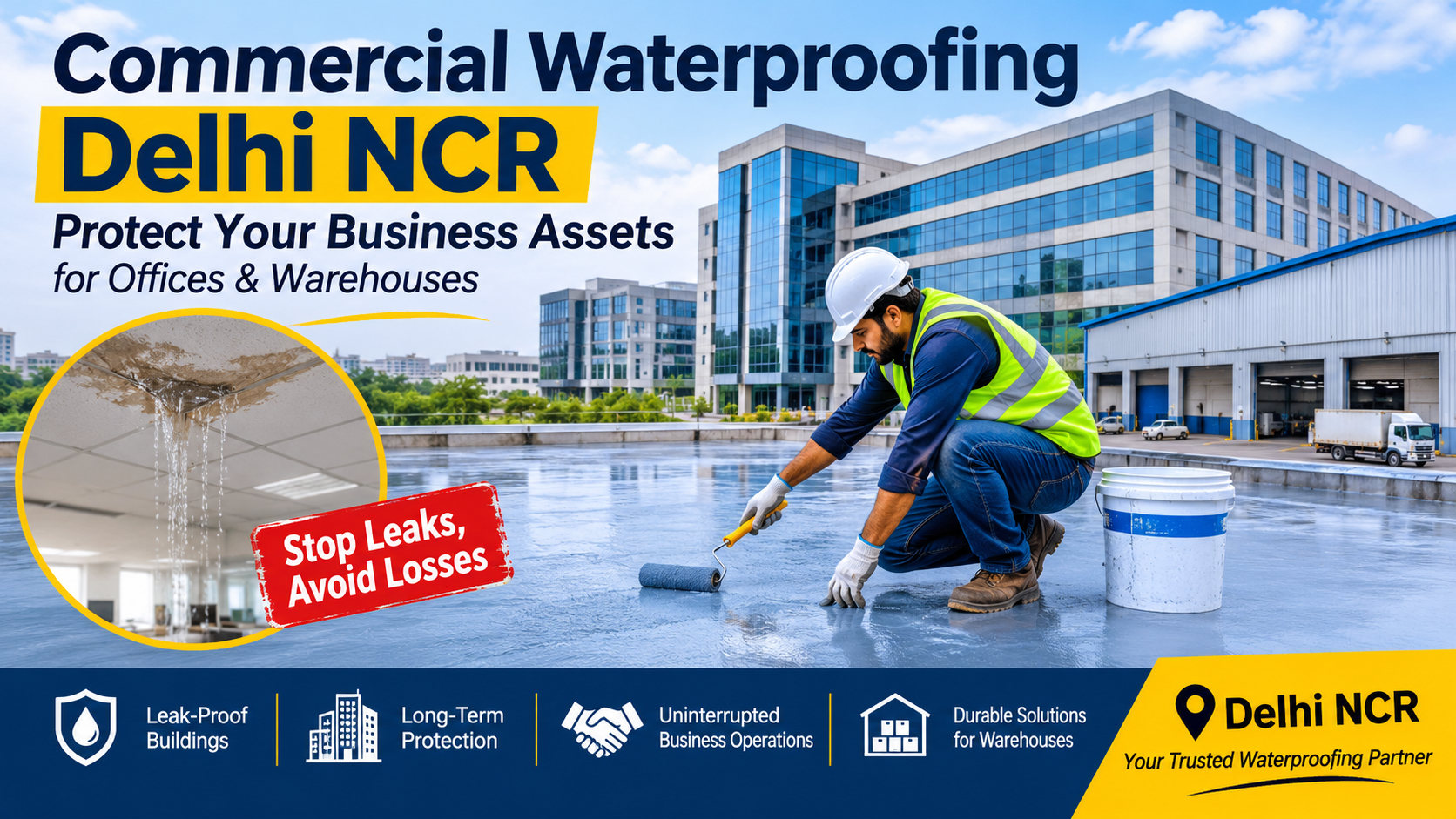
Water leakage in a commercial property is more than a maintenance problem. It can damage expensive equipment, destroy valuable inventory, interrupt daily operations, and gradually reduce the property’s market value. For business owners and facility managers, investing in commercial waterproofing delhi ncr is not simply about stopping water from entering a building; it is about protecting business assets and avoiding unnecessary operational losses.
Need this done for your office, warehouse or factory? See our commercial waterproofing service in Delhi NCR.
Delhi NCR presents particular challenges for commercial buildings. Extreme summer temperatures cause concrete surfaces to expand and develop micro-cracks, while intense monsoon rainfall exposes weaknesses in roofs, basements, and external walls. Areas such as Gurugram and Noida also experience groundwater-related challenges in certain locations.
Whether you manage a corporate office, manufacturing facility, logistics centre, or large warehouse, the right waterproofing strategy can prevent expensive repairs and keep your business running without interruptions.
The Hidden Costs of Water Seepage in Commercial Offices & Warehouses
Water seepage rarely causes its biggest damage on the first day. The real problem develops gradually, often behind ceilings, inside walls, beneath flooring, and around structural joints.
Consider a corporate office in Noida. A small leak above the false ceiling might initially appear harmless. However, continued moisture exposure can damage electrical wiring, lighting systems, networking equipment, and expensive workstations. If the leakage reaches server rooms or electrical distribution panels, the consequences can become considerably more serious.
Warehouses face a different challenge. A small roof leak can damage hundreds of cartons, packaged goods, raw materials, or electronic components. In facilities storing moisture-sensitive products, even minor leakage can make entire batches unsuitable for sale.
There are also structural consequences.
When water penetrates concrete, it can reach embedded steel reinforcement and accelerate corrosion. Over time, this may cause:
- Efflorescence: White salt deposits appearing on concrete and masonry surfaces.
- Concrete spalling: Concrete breaking or falling away because of reinforcement corrosion and associated expansion.
- Paint deterioration: Bubbling, peeling, and persistent damp patches.
- Mould growth: Moist conditions encourage mould, which can affect indoor air quality and employee comfort.
- Flooring damage: Moisture can weaken adhesives, damage wooden flooring, and affect industrial floor finishes.
The financial impact extends beyond repairing damaged surfaces. Businesses may face inventory losses, employee relocation, equipment replacement, insurance complications, and operational downtime.
This is why commercial waterproofing delhi ncr projects should focus on preventing water ingress at its source rather than repeatedly repairing visible stains.
Key Vulnerability Zones in Commercial Buildings
Every commercial building has different exposure points. However, our experience with building maintenance and restoration across Delhi NCR highlights three areas that deserve particular attention.
1. Basements and Underground Structures
Basements are among the most challenging areas to waterproof, particularly in locations with high groundwater levels.
Parts of Gurugram and Noida experience groundwater-related pressure depending on their location, soil conditions, drainage arrangements, and seasonal water levels.
When groundwater builds up around an underground structure, it creates hydrostatic pressure against basement walls and floor slabs. Even small construction joints, honeycombed concrete sections, or poorly sealed pipe penetrations can become entry points.
For effective office basement waterproofing ncr, contractors should investigate the actual leakage source before selecting a treatment.
Depending on site conditions, solutions may include:
- PU injection grouting for active cracks and water-bearing joints.
- Crystalline waterproofing treatments for suitable concrete substrates.
- HDPE membrane systems for new construction and accessible external surfaces.
- Internal drainage and sump-pump arrangements where groundwater management is necessary.
Simply applying waterproof paint over a leaking basement wall rarely solves the underlying pressure problem.
2. Warehouse Roofs and Metal Sheet Structures
Warehouse roofs often use GI sheets or other metal roofing systems because they cover large areas efficiently.
However, metal sheets expand during Delhi NCR’s hot summers and contract when temperatures fall. Repeated movement can loosen fasteners, damage washers, and weaken sealant around joints.
Common leakage points include:
- GI sheet overlaps and side laps.
- Rusted or loose J-bolts.
- Damaged EPDM washers.
- Ridge and valley joints.
- Roof penetrations for ventilation and equipment.
- Gutters and rainwater drainage outlets.
An effective warehouse roof leakage solution delhi requires more than applying a waterproof coating across the entire roof.
The contractor must inspect fasteners, joints, sheet condition, drainage slopes, and existing corrosion. Depending on the roof condition, suitable options include PU sealants, reinforced liquid-applied membranes, protective coatings, and replacement of damaged fasteners or sheets.
3. External Walls, Expansion Joints and Commercial Restrooms
Commercial buildings frequently experience leakage around external wall joints, window frames, balconies, washrooms, and service shafts.
Expansion joints deserve particular attention because buildings naturally experience thermal movement. When joint sealants become brittle or detach, rainwater can enter the building.
Restrooms are another common source of seepage, especially in multi-storey offices where leakage can affect ceilings and electrical installations on the floors below.
A proper commercial structure seepage treatment should identify whether the problem originates from plumbing leakage, failed waterproofing, defective joints, or cracks in the building envelope.
Treating the visible damp patch without correcting the source usually results in recurring complaints.
Modern Waterproofing Technologies vs. Traditional Remedies
Traditional methods such as brick bat coba have been used on Indian terraces for decades. They can still serve a purpose in suitable applications, but they are not automatically the right solution for modern commercial structures.
Today’s commercial waterproofing delhi ncr projects increasingly use specialised membranes, injection systems, and protective coatings selected according to the building’s exposure and movement requirements.
Here are the commonly used technologies:
1. Liquid Polyurethane (PU) Membranes
PU membranes form a continuous, flexible waterproof layer over properly prepared surfaces. They are particularly useful for terraces, podiums, and selected metal or concrete roof applications.
Their flexibility helps accommodate minor substrate movement, provided the system has the correct thickness, reinforcement, and detailing.
2. Polyurea Coatings
Polyurea creates a seamless, highly durable protective membrane with rapid curing characteristics.
It is useful in selected industrial floors, roofs, and demanding commercial applications. However, it requires specialised spray equipment, trained applicators, and careful surface preparation.
3. High-Density Polyethylene (HDPE) Membranes
HDPE membranes provide a physical waterproofing barrier and are commonly used in basements, retaining walls, foundations, and underground structures.
They are particularly suitable for new construction where the membrane can be installed and protected before backfilling.
4. Crystalline Injection Grouting
Crystalline systems penetrate suitable concrete substrates and help reduce water movement through capillary pores. Injection grouting, particularly PU injection for active leakage, can also seal cracks and water-bearing construction joints.
The correct selection depends on whether the structure has active leakage, static moisture, structural cracks, or groundwater pressure.
Comparison of Commercial Waterproofing Methods
| Method | Best Used For | Typical Durability | Key Advantage |
| Brick Bat Coba | Traditional concrete terraces | Variable; maintenance dependent | Established, economical terrace treatment |
| PU Membrane | Roofs, terraces and podiums | Often 8–15 years with suitable maintenance | Flexible, seamless protection |
| Polyurea Coating | Industrial floors and specialised roofs | Often 10–15+ years | Fast curing and abrasion resistance |
| HDPE Membrane | Basements and foundations | Often 15–25+ years when correctly installed and protected | Strong physical waterproofing barrier |
| Crystalline Treatment | Suitable concrete structures | Can provide long-term protection | Reduces water penetration through concrete |
| PU Injection Grouting | Active cracks and leaking joints | Depends on movement and water conditions | Targets specific leakage paths |
Note: Durability figures are indicative industry expectations, not guaranteed service lives. Actual performance depends on product specifications, installation quality, exposure, substrate condition, and maintenance.
For large commercial properties, experienced commercial building waterproofing services providers should evaluate the building before recommending a particular system. A product that performs well on an open terrace may not be suitable for a basement exposed to groundwater pressure.
How to Select the Right Industrial Waterproofing Contractor in Delhi
Choosing a waterproofing contractor based only on the lowest quotation can become an expensive mistake.
A reliable industrial waterproofing contractor delhi should understand commercial construction, large roof areas, industrial drainage systems, and the operational requirements of occupied buildings.
Before awarding a project, check the following:
1. Proper Site Inspection: The contractor should investigate the source of leakage rather than immediately recommend a coating.
2. Non-Destructive Testing: Ask whether the team uses thermal imaging cameras, moisture meters, and other suitable diagnostic equipment to identify concealed moisture and leakage patterns.
3. Material Selection: The contractor should explain why a particular membrane, sealant, or injection system suits your building.
4. Commercial Project Experience: Request references from previous office buildings, warehouses, factories, or industrial facilities.
5. Written Warranty: Check the warranty period, covered defects, exclusions, maintenance requirements, and responsibility for rectification.
6. Execution Planning: Work should be scheduled to minimise disruption to employees, tenants, inventory movement, and business operations.
A professional commercial waterproofing delhi ncr contractor should provide a clear scope of work, surface preparation details, application specifications, testing procedures, and handover documentation.
Frequently Asked Questions About Commercial Waterproofing in Delhi NCR
1. What is the cost of commercial waterproofing per square foot in Delhi NCR?
The cost depends on the surface condition, leakage severity, accessibility, material, and treatment method. Basic roof treatments generally cost less than specialised PU membranes, HDPE basement systems, or injection grouting. A site inspection is necessary to provide an accurate per-square-foot quotation.
2. Can waterproofing work be completed without disrupting office or warehouse operations?
Yes. Contractors can divide large areas into smaller working sections and schedule work during weekends, holidays, or non-operational hours. However, curing periods, safety restrictions, ventilation requirements, and access limitations must be considered.
3. Is commercial waterproofing possible during the monsoon?
Some emergency treatments and injection grouting systems can address active leakage during rainy weather. However, most external membrane applications require suitable weather, dry or appropriately prepared surfaces, and manufacturer-specified application conditions. Pre-monsoon execution is generally preferable.
4. How long does a commercial waterproofing warranty last?
Warranty periods depend on the waterproofing system, product manufacturer, contractor, and project conditions. Some systems offer shorter warranties, while specialised installations may carry longer coverage. Always review the written warranty instead of relying on verbal promises.
Protect Your Commercial Property Before the Next Monsoon
Water damage can affect inventory, infrastructure, employee safety, and business continuity. Investing in commercial waterproofing delhi ncr at the right time can prevent expensive restoration work later.
At Faith Infra Projects, we help commercial property owners identify leakage sources and select suitable waterproofing and structural protection solutions.
Don’t wait for the next heavy rainfall. Schedule a professional pre-monsoon waterproofing audit and protect your business assets before minor seepage becomes a major financial problem.
📞 Call us today at +91 9205955008 or visit www.faithinfraprojects.com to schedule your site inspection.